Showing posts with label Book. Show all posts

Saturday, October 24, 2020

Mental Toughness During a Pandemic

Seems like the title is a a paradox, right?  The pandemic, if anything, has affected our mental strength because there are so many unknowns, and stress, and impacts to our daily lives, etc.

And what about our pool game and mental toughness during these remarkable times?

I have written a couple of times this year that from my experience, if you have solid fundamentals, your game will not go down during the pandemic. So, stop sweating it or worrying if you can't play a lot of pool - your solid fundamentals will carry you!

While I wholeheartedly believe this deep in my soul, there is a part that I forgot.

Oooops.

I am being reminded because of the struggle, tough times, and nerves that Katniss and The Cueist (and maybe you if you are back to playing) are feeling lately. Katniss said after a little tournament she played in, "It's like I lost my kilter instinct" and The Cueist shared in his recent blog post, 

I started to get nervous! Now, don't get me wrong, I get nervous all the time. But I haven't felt nerves BEFORE walking into the poolroom since the early part of my pool career. The only difference was that this time around, I was nervous about not playing up to my usual expectations, and making a fool of myself.

I wrote about this same 'anguish' back in late 2016 - basically that I had played in a little tournament and while my fundamentals were solid still, my mental toughness was NOT, because I had not been playing in league or tournaments; I had cut down on my competing.

Yes, fundamentals are key. But, the brain is a muscle as well.  

Honestly, the only thing that keeps me from competing well after taking years off is not my stroke, but the pressure I feel. The more we put ourselves in pressure situations, we find ourselves becoming stronger and stronger in those situations. But, if you aren't competing, that part of our game, that big muscle, has not been worked on.

As I said two years ago, 

"The bottom line is, I know myself and based on my past attempts the last few years at playing in tournaments, I already know that I am only mentally strong when I'm consistently competing. Once I stopped competing, that mental toughness definitely went away for me. 

As a matter of fact, I noticed it was the first thing that went away for me.  Even though the brain is a muscle, for me my muscle memory in my arms and in my pre stroke routine were still there, but not in my mental toughness."

So, what can you do about this?

What would I do?

Take advantage of what you can control: I would read about mental toughness!  

If you can't play in high pressure situations, then improve your mental toughness the only other way if you can't compete: READ, LEARN.

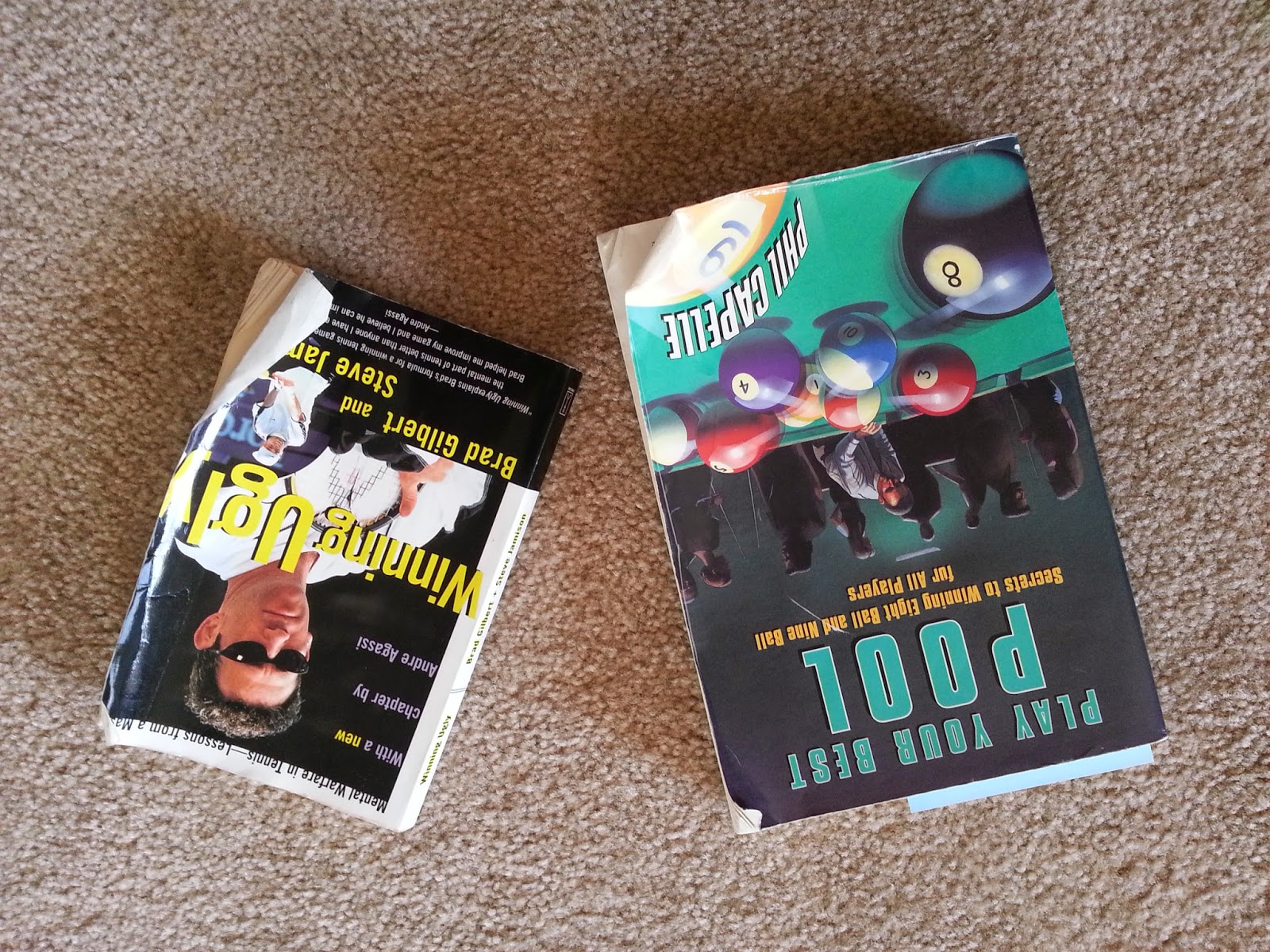
Winning Ugly is a book I have HIGHLY recommended a lot in my blog. You cannot read that book and not improve in your mental toughness arena.  I PROMISE. Therefore, pick up the book and read it when you can't compete. I also recommend Mental Toughness Training for Sports. But, the point is, find books or articles or watch video Ted Talks about mental toughness, how to gain the killer instinct, how to be mentally stronger, etc.  

I have this good book within arms reach right now,:


(watch out, you will also learn about leadership as well when you read about the mental toughness topic)

There are a ton of books out there for many different sports, but I recommend those about golf or tennis most.

I admit nothing can take the place of playing regularly in the middle of true pressure situations, but you can at least still work on it in other ways. Give yourself an advantage over your competitors for when you do start to play pool again. 

One side note. When I was in my late 20s, my mentor suggested I read Mental Toughness Training for Sports. I happened to be in a big slump and was playing terribly. So, I decided to take some time off and NOT play pool. And so I read that book during the time I wasn't hitting balls or competing. My mentor told me later, "I wanted to share that with you, but wasn't sure you would stop playing for a bit. Not playing pool while reading/learning about the mental game is a great plan."

Again, if you can't play pool, work on your game! 

Someone has to win, right? Might as well be you because you put in the time to improve in so many different ways even when you can't play pool regularly!

Monday, June 25, 2018

While You're Learning

Back in the mid to late 90s, my dear friend and top player, June Hager Walter, suggested I read a book entitled, Mental Toughness Training for Sports.  I wasn't sure why she suggested I read it at the time, but now of course it makes complete sense:  I needed some help with mental toughness!  It turned out to be a REALLY good book for me to read.  And, it was at the beginning of my pool journey and it was an enlightening book for someone who had never competing in sports before.  But it's a great book for all competitors, no matter where they are in their sports journey.

The bonus to this book was there is a section in it that explains how to "get in the zone."  I have consequently shared that concept with many people throughout my life, to help them in upcoming big tournaments.

But, that is not the topic of this blog post today.  Sorry!  Maybe I'll share "how to get in the zone" tidbit someday here in my blog, OR maybe you can read the book yourself :)

The other huge thing I learned from that book was, if you played your best, you gave your best effort, then you should not be upset at yourself if you lose.  I learned from Mental Toughness Training for Sports that if I played lazy or didn't give 100%, then I needed to accept that I didn't play my best.  This advice helped me from getting frustrated or depressed about my play.  I loved that info!  It was very helpful for me.

But the point of this blog post is something not even related to what was IN the book, but what I did while I read the book.

For whatever reason, I decided to stop practicing while I read the book.  Back then I was hitting balls several times a week.  But I wanted to focus on the words of the book and take the time to read it thoroughly with dedication.  So, I didn't hit balls the entire time I read it.

I mentioned to June in the middle of reading the book that I stopped hitting balls.  She confided that was exactly what I was suppose to do.  What?  I asked her, "Then why didn't you just suggest that to me?"  She replied she wasn't sure I would really do that, if she suggested it, lol.  But, it was kinda crucial to stop trying to improve my physical game while I read that book - I suppose so I could focus on one thing at a time.

While we can for sure multi-task (or so we think - check this out), it was imperative for my absorption to just focus on reading the book, and not also trying to improve my physical game at the same time.

Btw, the author is James Loehr.

Wednesday, December 13, 2017

Introducing: Capelle's Columns - 21 Years of Pool Instruction

Phil Capelle's new book is out!

Phil has been a columnist in Pool and Billiard magazine for 21 years, and EVERY SINGLE column is in this book!

And, oh, hey, look:  My name is on the first page!  (click photo to enlarge or buy your own copy via his website)


Okay, okay, enough about me.

This book is huge!  512 pages to be exact!  Photo doesn't do it justice, at all:


It contains:
  • 430 Diagrams​
  • Discoveries from Capelle’s research
  • Cross referenced
  • Position play
  • Shotmaking
  • Fundamentals
  • Safeties
  • 9&10 Ball
  • Eight Ball
  • Straight pool
  • Pro’s analyzed
  • Mental game
  • Much more …
Order yours today to get it by Christmas!

Friday, November 24, 2017

Acceptance of Your Level of Competing

I have wondered off and on throughout the years, what makes a person stop competing in pool?

I can recall numerous ladies I used to play with in Texas that don't play on the ladies tour anymore.  Was it because they got older?  Because they never got better and got frustrated?  Did life things get in the way (money, divorce, marriage, kids)?

I suppose for each person the reason is personally different.

And at one point, a successful player eventually isn't in the winners circle as much. What do they do then?  And how do they handle it?

Do they accept they are not as talented for some reason anymore, but yet still play?  Or do they stop competing due to frustrations?

Some people can't handle the disappointment and decide to move on from playing pool.  Some people accept they will never play at the level they used to play and are fine with playing for fun.  Some players frequent the pool rooms during the week on afternoons and enjoy sparing with friends, in lieu of competing in leagues and tournaments.

As I type all these words out, I am liking my reasons for retiring (after having a successful pool journey the last few years) more and more!  I can just imagine if I was to keep competing and eventually not be relevant or a formidable opponent how frustrating that could be.  I am liking my decision to choose to stop competing rather than having to stop not on my own terms.

Whatever their flavor is behind the reason, acceptance can go a long way in feeling good about their decision.

Btw, in case you are curious why these thoughts came up this week, it was after I read this excerpt from "What I Talk About When I Talk About Running" by Haruki Murakami:
"I don’t care about the time I run. I can try all I want, but I doubt I’ll ever be able to run the way I used to. I’m ready to accept that. It’s not one of your happier realities, but that’s what happens when you get older. Just as I have my own role to play, so does time. And time does its job much more faithfully, much more accurately, than I ever do. Ever since time began (when was that, I wonder?), it’s been moving ever forward without a moment’s rest. And one of the privileges given to those who’ve avoided dying young is the blessed right to grow old. The honor of physical decline is waiting, and you have to get used to that reality. Competing against time isn’t important. What’s going to be much more meaningful to me now is how much I can enjoy myself, whether I can finish twenty-six miles with a feeling of contentment. I’ll enjoy and value things that can’t be expressed in numbers, and I’ll grope for a feeling of pride that comes from a slightly different place. I’m not a young person who’s focused totally on breaking records, nor an inorganic machine that goes through the motions. I’m nothing more or less than a (most likely honest) professional writer who knows his limits, who wants to hold on to his abilities and vitality for as long as possible."


Thursday, May 5, 2016

Honored by Phil Capelle

Pretty cool when famous billiards author Phil Capelle asks you to review his new book and then you find your quote in the book!

Just received this gem in the mail yesterday:

My own personally-signed copy!


Here is my review:

(click to enlarge)

Six Words to Pool GREATNESS is now available via his website for ordering TODAY.  Shipping cost is included, too :)

If you loved his "Laws for Pool" in his A Mind for Pool book, then you'll enjoy this book even more.


Friday, October 23, 2015

Getting in the Zone is Not Key for Me

I read in Mental Toughness Training for Sports how to get "in the zone."  I read it in my mid 20s, and will never forget it. 

I have known how to do this for years.  Sometimes it works, sometimes it doesn't.  But what I know now is even more valuable:   While everyone thinks getting in the zone is huge, I think being confident and being in control of your fundamentals are MORE important.

I prefer to have confidence in my abilities and to feel confident about them.  I prefer to know that staying down and following through is more valuable than being in the zone.  I prefer to know that having a smooth stroke and taking my time helps me make more shots.  I prefer to recognize that I need to breath under pressure.  I prefer to recognize that if I'm focusing on fundamentals, that also helps my mental toughness as well. 

Sure, being in the zone is amazing.  And it's a feeling like none other. 

But that cannot be achieved every time.  You know what can?   Knowing that staying down and solid fundamentals are what you can bring to the table every time.  Obviously, knowledge is KEY, also, but the combo - wow - is priceless. 

And THAT feels better than being in the zone.

I want to be clear.  BEING confident is one thing, but being confident and in control in your fundamentals is quite another.  It's one the best feelings in the world is focusing on staying down with a smooth stroke on every shot of a match. 

I recall how my ex boyfriend had a real big money match the following day that was set up.  He was playing a set for $5,000.  I was at home back in Texas and he was to play a guy in Alabama I think (this was 20 years ago).  *I* could not go to sleep.  I wondered, "how could he sleep and not wonder about the match or how it would go?  How could he not be nervous?"

I know now.  He was confident in his ability. 

I get more sleep before big events now than ever before.  I don't fret about how I might do or worry about it.  I don't get nervous because I'm the clutch player in all my team events.  Nope.  I sleep like a baby because I'm confident with my fundamentals and the knowledge of the game.

Zone?  pffft.  Even the best athletes in the world admit that they have only been in the zone a handful of times.  Wish I had instead the last 20 years the knowledge that focusing on solid fundamentals would win me more matches. 


Monday, April 14, 2014

My Biggest 8 Ball Advice!

I have said this a thousand times, and have kinda proven it helps, but people still don't do anything about it.

I have recommended to help your 8-ball game to read the 8-ball portion of Play Your Best Pool by Phil Capelle.


I became a Master player in 2002 because I read the book.

After a hiatus from competing, I was moved back down to the Open, but then I re-read that 8-ball section several times and won ACS Texas State Women's Singles in 2011, and then won BCAPL Nationals Women's Team event in 2012 and 2013. 

And most recently, placed first at 2014 BCAPL Texas State Championships.

I am more agitated about all this because of two recent things:

(1)  I saw the way some players played at the BCAPL Texas State 8-Ball Championships, and
(2)  A recent post on FB got me all riled up, lol.

(1) I was very perturbed as I sat there at the tourney and watched players do all sorts of crazy things because they have not learned how to play 8-ball.  It can't be learned from 9ball or by playing league.  I played for 12 years and never knew these things about 8-ball, UNTIL I read just that small section of his book.

And I do not really like to read - and it's a VERY easy read! 

Every page has a diagram on it, and Phil Capelle explains what you should or should not do in certain circumstances.

For instance, I saw these things at the tourney (and also during league):

  • Player makes all their balls and leaves their trouble ball last. WRONG.  You are suppose to try and get your trouble ball out early!  If you can't, then at least STOP making your balls!
  • Player doesn't take advantage to remove one ball of the two balls that are on the same bottom rail.  WRONG.  Omg please read the book!  When two of your balls are on the same bottom or top rail, it's almost impossible to get shape on them both at the same time, unless you happen to get ball-in-hand or get lucky.  Instead, eliminate one, then come back later for the other.
  • Player doesn't improve their balls, they just play safe, not realizing they should move their ball around to a better position.  WRONG.
  • Player keeps making their balls, when they should instead play safe.
  • Player doesn't even think about the ball they are going to use to set up on the 8ball ("key ball").  WRONG.
  • Player doesn't see they can break out their ball with a safe because their opponets' balls are tied up.  
  • Player doesn't realize they "should" leave their opponent a shot, so THEY can break up the cluster.

I could go on and on!

The book helps so much of what I did not know and would NEVER have known just by playing league or even just playing in tournaments.

Now, I'm not saying there is only ONE correct way, but there are very obvious choices at certain times in a match that a lot of players still do not know.

And that's okay!  

How are we suppose to really understand these amazing things about 8-ball on our own?  It's strategy, which is why I love 8-ball.

And I think the MAIN reason I saw all this this past week is b/c I refreshed myself on 8-ball extensively before the tourney by reading his 8-ball section twice.  So, it was all very fresh in my mind.

I swear I feel like I should put on a little clinic, lol!

(2) Then on FB a friend of mine asks how he can improve his 8-ball game.  He felt his 9-ball game was good, but wasn't sure why his 8-ball game wasn't.

OMG, I was SO shocked by some of the responses!

  • "Practice more."
  • "It's mental."
  • "Focus on your pre-shot routine."
  • "Think ahead."

OMG people!  Those reasons are NOT why his 9ball game is better and those things will NOT help his 8ball game.

I know I sound passionate and a little harsher than normal above, but I am frustrated because the answer is so simple, really.

And here is a perfect example:

A friend of mine (Cindy) posted on Facebook during the same tourney a few times about defense:  "I have decided it is just going to be a defensive weekend. "  And "...shot like crap had to play defense just to win." 

Her and I talked about this in between matches and she said she's finally figured out what I've been trying to say for the last couple of years (lol) about defense and strategy in 8-ball.  She played in the B-Division and placed an impressive SECOND! 

I asked her about Phil's Book for this blog entry (so you don't think it's all coming just me, lol):

"I took up pool very late in my life (August 2010) and was reading quite a bit of information but I was all over the place and was trying to do things way over my head. Then Melinda Bailey came along and suggested Phil Capelle's books. First thing I noticed was how it was laid out. It didn't matter whether I was a beginner or advance player; it was perfect. The suggestions asking yourself why for things such as missing a shot or losing a game. It mentally prepares your mind if you can take the time to read sections before tournament play. Before reading the books, I would look at the table like it was a bunch of skittles. No plan or map. I still have a lot of work to do but I am getting there. To sum it up in a couple of sentences, his books have helped me mentally, strategically, and with my confidence. It has slowed my game down which allows me to make better decisions at the table."

Thank you, Cindy!

Now, I am not saying you will magically become an 8-ball beast. You still need to have good fundamentals and still be able to make shots.  But even if you don't have those things, you will see an 8-ball layout in SUCH a different light.  You will see things not many people see.  You will love the game more because you understand it more.  And you WILL win more games. 

Because I am such a firm believer that it will help, I will do this:  If you buy Play Your Best Pool by Phil Capelle online, shoot me an email and then I will GIVE you $7!  I am serious!

I have some on-hand because I am Phil's webmaster.  If you buy it from me in person, you will get an even bigger discount, but obviously not everyone lives in the DFW-area.

Either way, I'll either give you money or give you a discount.

Please help yourself people!  You will THANK me, and be much happier with your game.  I PROMISE.

:)


Monday, March 31, 2014

Preparing for the Unprepared

I've mentioned I'm in a rut. 

I am.

Timing is horrible!

I'm playing in the BCAPL Texas State tourney that starts this week.  And I'm unprepared.

As I said in my Rut Uh blog entry, "anyone that reads this blog the past few years know that is the one tourney I've always wanted to win. "

I haven't practiced.  I haven't hit balls.  Both my Monday and Thursday night leagues are on hiatus.  Haven't played weekly tourneys.  Nothing.  No table time.

When I do play on Sundays during league, I can see just how badly I'm playing.  :(

So, I decided to prepare for the unprepared.

I have to face facts.  I'm not playing well.

While I want to say, "Oh, hey, this will allow me to just have fun and not think of this title tournament."  But we all know how that goes.  Especially if we are playing badly.

So, I'm resigned to the fact I prolly wont do well.  And I'm okay with that.  If I haven't prepared, then I am unprepared to do well.  Right?  Fact. 

I have to admit I DID read the eight-ball section of Play Your Best Pool (my FAV 8ball book) by Phil Capelle TWICE in two weeks.  AND Brad Gilbert's Winning Ugly (my FAV mental book) also TWICE in two weeks!


Hey, I didn't JUST sit around doing nothing.  lol.

I just need to be very self aware this week.  Come on, Melinda!


Monday, February 4, 2013

Review: Mastering the Inner Game of Pool

I received an email a while back from David Krolick who said he wrote a small book on mental toughness. 

At first I was like, damn, I don't read a lot of books, but after I downloaded it, I saw it was only 22 pages (and that included the front and back pages).

My kind of book :)

I have been meaning to write this review for MANY months and I apologize in advance to David for taking so long. 

Honestly, I read it the second day I had it in my hot little hands.

I learned some good tips from the pages right away!  I have used some certain mental tips the last few months.  While some of the things he shares I have already experienced and know, there are tidbits that were new to me and I'm glad I read it.

I only have one complaint:  (and this is ironic), I wish it was longer!  It's chalk full of really fantastic mental advice and help that I wish it kept going and going!  He states suggestions clear and easy-to-read, and he could even elaborate on them.  But more so, I yearned for more because it was so helpful.

The biggest thing I got from his book was "The Subconscious Mind" section.  I'd like to share the specific secret I keep using in my matches, but will only do so in person if you ask me - otherwise, you'll have to get the book yourself either as an e-book or via Amazon on Kindle.


With the book being so short, I can't possibly even give up one tip.  No begging!

Thank you David for taking the time to write this mental toughness book for the players who want to improve their game!

-------------

Description of Mastering the Inner Game of Pool:  Thinking is fine for some things but can be a major distraction while trying to execute a pool shot. Baseball great, Yogi Berra put it this way: "You can't think and hit at the same time." The fact is that whenever you combine thinking and doing, the doing will always suffer.

Mastering the Inner Game of Pool will help you to solve this common dilemma. This small book will show you how to quiet your mind and allow the shot to happen unhampered by unnecessary thought.